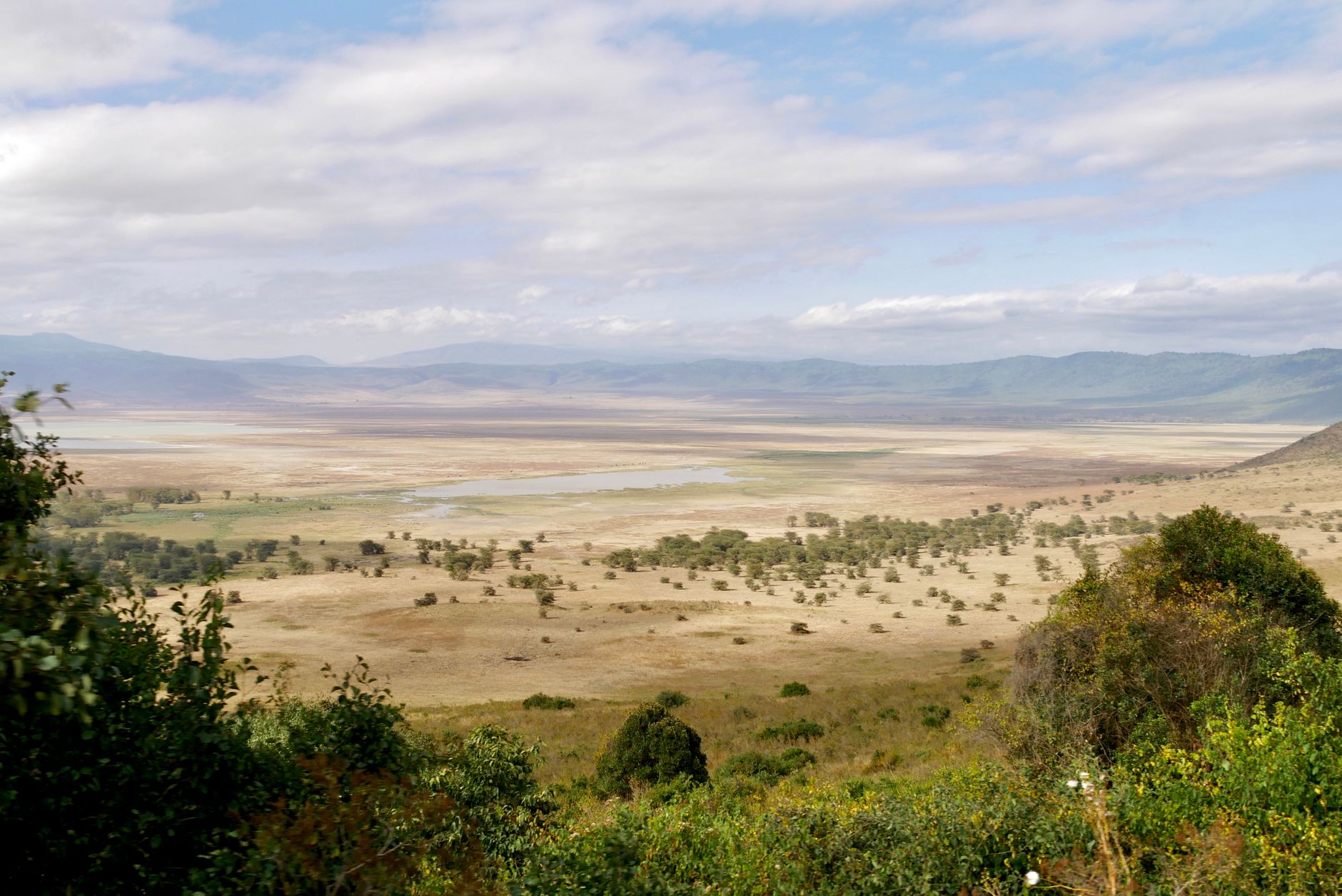


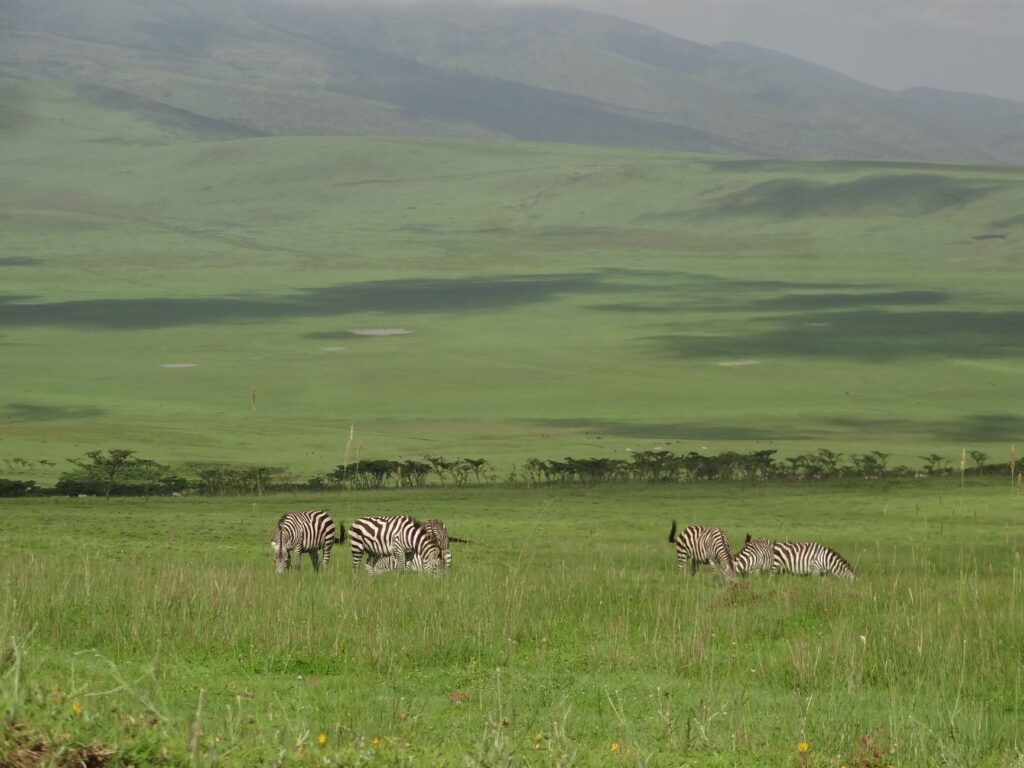
Your very first encounter with the magnificent Ngorongoro Crater is always a special moment. Approaching its edge, the ground falls away dramatically to unveil a sweeping panorama: a colossal, ancient basin plunging 600 metres, creating a spectacular natural amphitheatre which spans 265 square kilometres, and encloses a rich, self-sustaining ecosystem. Here Maasai tribes share the fertile terrain with roughly 30,000 wild animals. Within these steep, protective crater walls, the landscape shifts from lush fever-tree forests and marshy wetlands to shimmering alkaline waters of Lake Magadi, which glows pink with thousands of feeding flamingos.
This concentrated haven offers a highly rewarding safari, providing a reliable home for apex predators and grazers alike. It remains one of the premier destinations in East Africa where you may witness the entire ‘Big Five’ — lions, leopards, elephants, buffalo, and a precious, thriving population of endangered Black Rhinos that continue to breed safely in the wild. Ngorongoro Crater represents an unmatched natural spectacle that no traveller should miss.
Read on More about this place
The world’s largest intact volcanic caldera
Roughly two to three million years ago, a volcano here erupted and its cone collapsed inward, leaving behind the largest unbroken, unflooded caldera on earth — a natural amphitheatre about 19 kilometres across, its walls rising 400 to 600 metres above a floor of 260 square kilometres. Before it collapsed, geologists believe Ngorongoro may have stood as tall as Kilimanjaro itself. What is left is essentially a sealed ecosystem: grassland, swamp, acacia woodland and a shallow soda lake, walled in on every side, holding an estimated 25,000 large animals in a space small enough to see a meaningful cross-section of them in a single day.
A concentration of wildlife with almost nowhere to hide
Because the crater floor is enclosed and well-watered year-round, its animal population does not migrate the way the Serengeti‘s does — the density here is constant, not seasonal. Lion prides on the crater floor are among the most closely studied in the world, and sightings are close to guaranteed. Elephant on the floor are almost always old bulls carrying the heaviest ivory left in East Africa, since cows and calves largely stay in the surrounding highland forest. Hippo crowd the Ngoitokitok springs, flamingo gather in their thousands on Lake Magadi when conditions are right, and the crater remains one of the last strongholds of the endangered black rhino in Tanzania — fewer than a hundred are thought to remain in the conservation area, usually seen only at distance across the open floor.
Chance to see black rhino
The Ngorongoro Conservation Area, and the Maasai who live in it
The crater sits inside the 8,292-square-kilometre Ngorongoro Conservation Area, a UNESCO World Heritage Site since 1979 and unique among Tanzania’s protected areas for permitting human settlement alongside wildlife. Around 87,000 Maasai pastoralists live within its boundaries, grazing cattle across the highlands in a deliberate policy of multiple land use dating to the area’s creation in 1959 — a compromise that remains debated but that means visitors regularly pass Maasai herders and their cattle on the road to the crater rim, inside a World Heritage Site rather than outside one.
Getting down, and where to stay
Most visitors descend into the crater for a single full day — typically from a lodge on the rim itself or from the town of Karatu, roughly 40 minutes below — via one of two steep access roads, with a picnic lunch at the hippo pool breaking up a full-day game drive. A separate vehicle fee applies on top of the conservation area entry fee, which we build into every quoted price rather than adding it as a surprise later. The crater is the centrepiece of nearly every Northern Circuit itinerary we run, from the 4-Day Ngorongoro & Serengeti to the full 8-Day Full Northern Circuit, and it sits within easy reach of Olduvai Gorge and the walking route down into Empakaai Crater for those with a day to spare.
At a glance Facts, season & highlights The essentials, and what makes this place.
Tanzania
The world's largest volcanic crater still in one piece, full of wildlife.
What it looks like


Dry crater floor, busiest months
The crater's resident wildlife is on view essentially year-round, so the real seasonal difference is conditions: dry and dusty, and the most crowded months to descend to the floor.
Highlights, up close

Where it is
- Best time to visit June to October and January to February
- Climate The rim is genuinely cold — often below 10°C at dawn above 2,200 m — while the crater floor below is mild; layers are essential for the early descent.