
Overview About this route
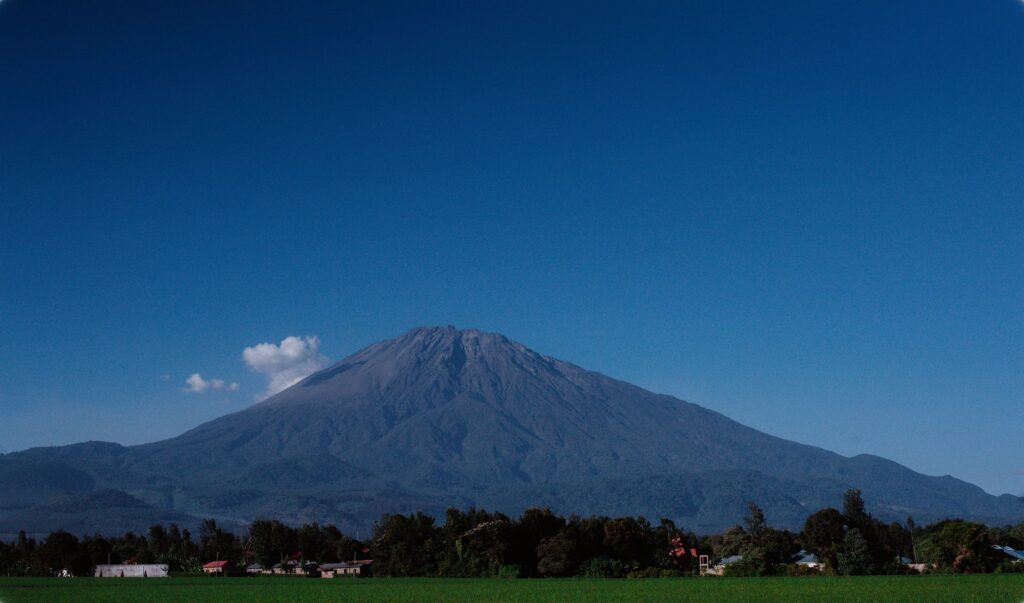
A 4-day trek up Mount Meru (4,566m) inside Arusha National Park, with an armed-ranger escort through forest and moorland to a dramatic crater rim.
Day by day The route
The itinerary
-
Momella Gate at around 1,500 metres, registration, and then straight into forest. The first day of Meru is the one nobody expects: you walk with an armed ranger not as ceremony but because this is a national park with buffalo and elephant in it, and the trail goes through their ground.
The forest is thick, wet and loud. Colobus monkeys move overhead. Giraffe are common in the more open sections — Arusha NP has a very high density and you often walk within thirty metres of them. The fig tree arch, a natural archway formed by two trees grown together, is on this section and everybody stops there.
Four to six hours to Miriakamba Hut at 2,500 metres. The huts on Meru are basic but solid — bunks, mattresses, a dining hut — which means no tents to pitch.
-
The forest thins into moorland and the vegetation changes completely — giant heather, everlastings, and then the open ridge. Two to four hours to Saddle Hut at 3,570 metres.
In the afternoon there is an acclimatisation walk up Little Meru (3,801 metres), which takes about an hour and is optional but strongly recommended. It is the single best thing you can do for your summit chances, and the view down into the crater from up there is worth the effort on its own.
-
This is the hard day.
The route to Socialist Peak (4,566 metres) follows the crater rim, and the rim is the defining feature of this mountain. Meru blew its eastern flank out in an enormous collapse — what remains is a horseshoe caldera with a sheer inner wall, and you walk the top edge of it in the dark with the ash cone below you on one side. There is genuine exposure in places. The ground is loose underfoot.
Four to five hours up. You reach the summit at dawn, and this is why people climb Meru rather than only Kilimanjaro: from the top you look east and Kilimanjaro is directly in front of you, floating above the cloud with the sun coming up behind it. It is arguably the best view of Kilimanjaro available anywhere, and you cannot get it from Kilimanjaro.
Then all the way down to Miriakamba — a very long day, ten to twelve hours in total.
-
Down through the forest to Momella Gate, three to four hours, and back to Arusha by early afternoon.
As Kilimanjaro preparation: this is the best acclimatisation available in Tanzania. Four days, a genuine 4,566-metre summit, and a real understanding of how your body handles altitude — all before you commit to a much more expensive climb. Most guides here recommend a gap of at least a few days between the two.
As a climb in its own right: Meru is harder per day than Kilimanjaro’s easier routes, far less crowded, and more varied. You will meet a handful of other trekkers rather than a queue.
Fitness: You need to be genuinely fit. Summit day is long and the rim has exposure that a nervous walker will find difficult.
What to bring: proper boots, warm layers for the summit (it is below freezing at dawn), headtorch, and walking poles — the descent on day three punishes knees.
At a glance Summary, facts & pricing The climb in numbers, and what it costs.
Tanzania's second-highest peak, and a superb Kilimanjaro warm-up
Pricing by comfort level
Best season June-October and December-March
$922 per person
Best season June-October and December-March
$1,127 per person
Best season June-October and December-March
$1,568 per person
Per person, land only — international flights not included. Final pricing depends on your dates and group size; ask us and we will quote exactly.